The 30-Minute Marketing Week: AI Systems for Owners Who Don't Have a Marketing Team
You don't have a marketing team. You have a Tuesday morning between a supplier call and a job site visit, and the vague guilt that you "should be doing more marketing." This guide is for you — and the fix is not more discipline. It's a set of five always-on AI systems that run your marketing in the background, while your actual job stays running the business. Your weekly role shrinks to one focused, 30-minute review. Here's exactly what that looks like, what it costs, and what the numbers say it's worth.
The premise is already proven. In Intuit QuickBooks' April 2025 survey of more than 2,200 small businesses, 74% of owners using AI said it made them more productive — up from 46% the previous summer — and 24% said their workdays got shorter. Marketing is the single biggest place those hours come from, because it's repetitive, deadline-driven, and mostly follows a pattern. Patterns are exactly what AI is good at.
Why "Do More Marketing" Is the Wrong Goal
The advice every owner gets — post more, email more, blog more, "be consistent" — assumes you have a team's worth of hours. You don't. So marketing becomes the first thing dropped when the week gets busy, and the stop-start pattern is what actually kills results, not the quality of any single post or email.
AI changes the math because it attacks the time problem, not the effort problem. HubSpot's 2026 State of Marketing report, which surveyed over 1,500 marketers, found that about two-thirds of teams using AI save 10 or more hours per week — roughly a third save 10 to 14 hours and another third save over 15. Those are professional marketers. For an owner doing everything, the same leverage applies, and it matters far more because those hours were coming out of operations, sales, or your weekend.
The goal of the 30-minute marketing week is not to make you a better marketer. It's to make marketing a system you supervise instead of a job you do.
The One Operating Rule: Automate the Recurring, Review the Human
Everything in this system hangs on one rule. AI handles the work that's recurring, rules-based, and time-sensitive — the follow-up email that should go out in five minutes, the weekly Google Business Profile post, the newsletter draft. You handle the 30 minutes a week where human judgment actually moves the number: approving what goes out under your name, replying to the lead who's ready to buy, and deciding what to do more of.
This split matters because it's where AI for small business actually earns trust. Salesforce's sixth Small & Medium Business Trends report, a survey of 3,350 SMB leaders, found that 91% of SMBs using AI report a boost in revenue and 90% report more efficient operations — and growing SMBs are nearly twice as likely to invest in AI as declining ones. The businesses getting those results aren't "letting AI run the company." They're running systems where AI does the volume and a human keeps the keys.
The Five Systems That Run the Week
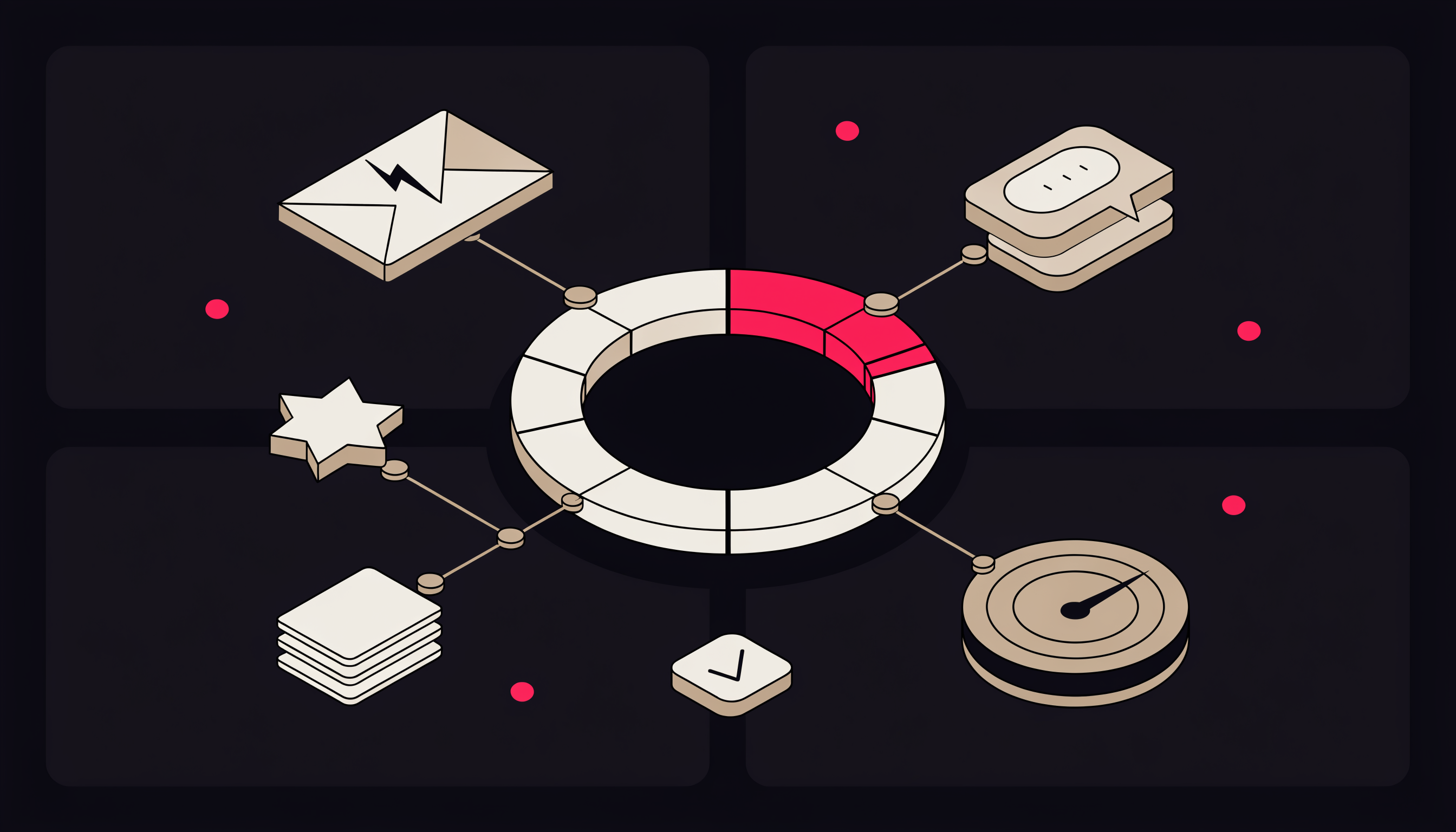
You don't need twenty tools. You need five systems, each doing one job, all feeding a single weekly review.
1. Speed-to-Lead: Every Inquiry Answered in Under a Minute
When someone fills your contact form, requests a quote, or messages your Google profile, an automation fires an immediate, personalized reply — answering the obvious questions, setting expectations, and offering a booking link — before they've called your competitor. We broke down the full mechanics in our guide to speed-to-lead automation: the difference between a 5-minute and a 30-minute response is the difference between qualifying a lead and losing one. For most owners this single system is the entire ROI, because it converts marketing you already paid for instead of letting it rot in an inbox.
2. Nurture and Review Engine: Email That Runs Itself
Every new contact drops into a short automated email sequence — a welcome, a proof point, an offer — and every completed job triggers a review request. Email is the highest-return channel most small businesses have; Litmus' email ROI research puts the average return at $36 for every $1 spent, higher than any other channel. An AI assistant drafts the sequence in your voice once; automation sends it forever. Your only job is a monthly glance at open and reply rates.
3. Google Business Profile: Local Visibility on Autopilot
For most local and service businesses, the Google Business Profile drives more calls than the website. AI drafts your weekly post, suggests review responses, and keeps services, hours, and Q&As current — the exact signals that also feed how AI assistants recommend local businesses, which we covered in how to get your business recommended by ChatGPT. You approve the week's post in about two minutes.
4. The Content Engine: One Idea, Five Assets
Once a week you give the system one raw input — a voice memo from the truck, a customer question you answered three times, a before-and-after. AI turns it into a short blog post or FAQ, a few social posts, and an email blurb. You edit for accuracy and tone. This is how an owner with no team ships consistent content without a "content calendar" they'll abandon by week three.
5. The Mini-CRM: One Place Where It All Lands
Every lead, reply, booking, and review request lands in a simple CRM or even a structured spreadsheet, so nothing depends on your memory. This is the unglamorous backbone — and it's why the whole thing fits in CRM automation rather than "AI magic." Without it, leads leak. With it, your 30-minute review has a single dashboard to look at.
What the 30 Minutes Actually Look Like
The systems run all week. Your job is one focused block. Here's the agenda:
| Minutes | What you do | What you're checking |
|---|---|---|
| 10 | Review lead replies | AI-drafted responses waiting for approval; hot leads flagged for a personal reply |
| 5 | Approve content | This week's Google post, social posts, email blurb — edit, approve, or regenerate |
| 10 | Look at the numbers | New leads, response time, bookings, email opens, review count — vs. last week |
| 5 | Decide one thing | One adjustment: push the offer that worked, fix the email that didn't |
That's the whole job. Everything else — the sending, the reminding, the posting, the logging — already happened without you.
What It Costs and What It Pays Back
The honest tool budget for this stack is $100–$300 a month for most small businesses: an automation platform, an AI assistant, an email/CRM tool, and a scheduling link. Against that, do the owner math. If AI saves you even five of the ten-plus hours a week that most marketing teams report, and your time is worth $75–$150 an hour, you're reclaiming $1,500–$6,000 a month in owner capacity — before counting a single new customer.
Then count the customers. If your speed-to-lead system rescues one job a month that would otherwise have gone to voicemail, and your average job is worth a few hundred to a few thousand dollars, the stack pays for itself several times over on that system alone. We walked through the same break-even logic for a single one of these systems in our AI receptionist cost and ROI breakdown — the pattern is identical: one or two recovered jobs a month typically covers the entire tool bill.
And if you're weighing this against doing it all by hand or hiring it out, the comparison in DIY vs. agency vs. AI will look familiar: AI plus a 30-minute owner review is the only model that fits a budget measured in hundreds, not thousands, per month. For the broader question of how much to spend overall, see our 2026 small business marketing budget benchmarks.
How to Build It in Four Weeks (Without Overwhelm)
Don't build five systems at once. Build one a week, in order of ROI:
- Week 1 — Speed-to-lead. Connect your contact form and Google profile to an instant auto-reply with a booking link. This alone changes your close rate.
- Week 2 — Nurture and reviews. Load a three-email welcome sequence and an automated post-job review request.
- Week 3 — Google profile and content. Set up the weekly profile post draft and the one-input-to-five-assets content flow.
- Week 4 — Dashboard and review. Pull leads, bookings, and email stats into one view and run your first 30-minute marketing week.
By the end of the month, marketing is a system you check, not a chore you dodge.
Frequently Asked Questions
Can AI really handle my marketing in 30 minutes a week?
AI handles the recurring, rules-based work — follow-ups, posts, sequences, review requests. The 30 minutes is your review and approval layer: checking replies, approving content, and reading the numbers. Strategy and any judgment call stay with you; the busywork doesn't.
What's the minimum I need to spend on tools?
Most owners can run this stack for $100–$300 a month. Start with one system — lead follow-up — prove the return, then add the rest. One recovered job a month usually covers the entire bill.
Which system should I set up first?
Speed-to-lead, always. It's the fastest payback because it converts marketing you already paid for. Everything else compounds from there.
Will AI-drafted content sound generic and hurt my brand?
It will if you publish it untouched. The model here is AI drafts, you edit. You supply the raw material — real customer questions, real jobs, your point of view — and spend your minutes on accuracy and tone. The draft is the labor; the voice is yours.
Do I need to be technical to set this up?
No. Modern automation and AI tools are built for non-technical owners, and most of this connects with point-and-click. The harder part is deciding what the systems should say — which is a business decision, not a technical one.
The Bottom Line
The 30-minute marketing week isn't about doing less marketing. It's about finally doing it consistently, because a system — not your willpower — is doing the work. Five AI systems, one weekly review, and a tool bill that one recovered job covers. That's how an owner with no marketing team out-executes competitors who are still "meaning to post more."
If you'd rather have the whole stack designed, connected, and tuned for your business — lead response, nurture, local visibility, content, and reporting — that's exactly what we build. Book an AI consultation and we'll map your 30-minute marketing week in a single working session. For more playbooks like this, browse the Optimal blog.
Ready to turn AI into measurable growth?
Let's discuss how we can build smarter systems and stronger campaigns for your team.
Book a Discovery Call